Fees
Phone Consultation (15 minutes) - Free
Telehealth individual sessions (60 minutes) – $160
Face-to-face sessions (60 minutes) – $180
Initial consultation (120 minutes) - $220
Home visit (without mobility issues) – $220
Home visit (with mobility issues) – $180
NDIS funded therapeutic support – $193
Sliding Scale Fees
A limited sliding scale may be available for clients who meet BOTH of the following criteria. Fees are discussed individually based on financial circumstances:
Individuals or families with limited financial capacity (e.g. single parents, low-income households, Centrelink recipients, young adults in major life transitions).
Clients experiencing significant mental health difficulties who do not yet meet eligibility criteria for public services or other affordable options (for example, have exhausted PSS and not eligible for Victim Support Scheme).
Proof of financial hardship (e.g. a payslip or Centrelink statement) will be requested.
Sliding-scale fees can be reviewed if circumstances change. If your financial situation improves during treatment, I appreciate a return to the standard fee and trust clients to communicate changes in good faith.
💳 Available Rebates
Medicare Better Access
Up to 10 sessions per calendar year with a GP Mental Health Care Plan
Rebate: $89.25 per session
Application process:
If you are eligible for Medicare and experiencing mental health difficulties, please visit your GP to obtain a Mental Health Care Plan (MHCP). Once the plan is in place, you may contact me to arrange appointments.
Medicare Eating Disorder Treatment Plan
Up to 40 sessions per calendar year with a GP Eating Disorder Care Plan
Rebate: $89.25 per session
Application process:
If you are eligible for Medicare and experiencing an eating disorder, please see your GP to request an Eating Disorder Care Plan (note: a standard Mental Health Care Plan only subsidies 10 sessions). Once the plan is completed, you may contact me directly to commence therapy.
Private Health Insurance
Rebates may be available depending on your fund and level of cover. Please check directly with your insurer regarding rebates for sessions with an Accredited Mental Health Social Worker.
NDIS
Sessions may be funded under the Therapeutic Supports category.
You may contact me directly for invoicing arrangements. If you have an NDIS Support Coordinator, you are welcome to pass on my contact details or request that I liaise with them directly.
NSW Victims Support Scheme
Up to 22 hours of counselling at no cost for eligible clients
Application details are available here:
https://victimsservices.justice.nsw.gov.au/how-can-we-help-you/victims-support-scheme/make-an-application.html
Once your application is approved, you may contact me directly.
My profile is also listed on the NSW Victims Support Scheme website:
https://victimsservices.justice.nsw.gov.au/how-can-we-help-you/victims-support-scheme/find-an-approved-counsellor.html
To find my profile, select “Search by counsellor name” and enter “Qian Wang.”
Telehealth vs Face-to-Face Sessions
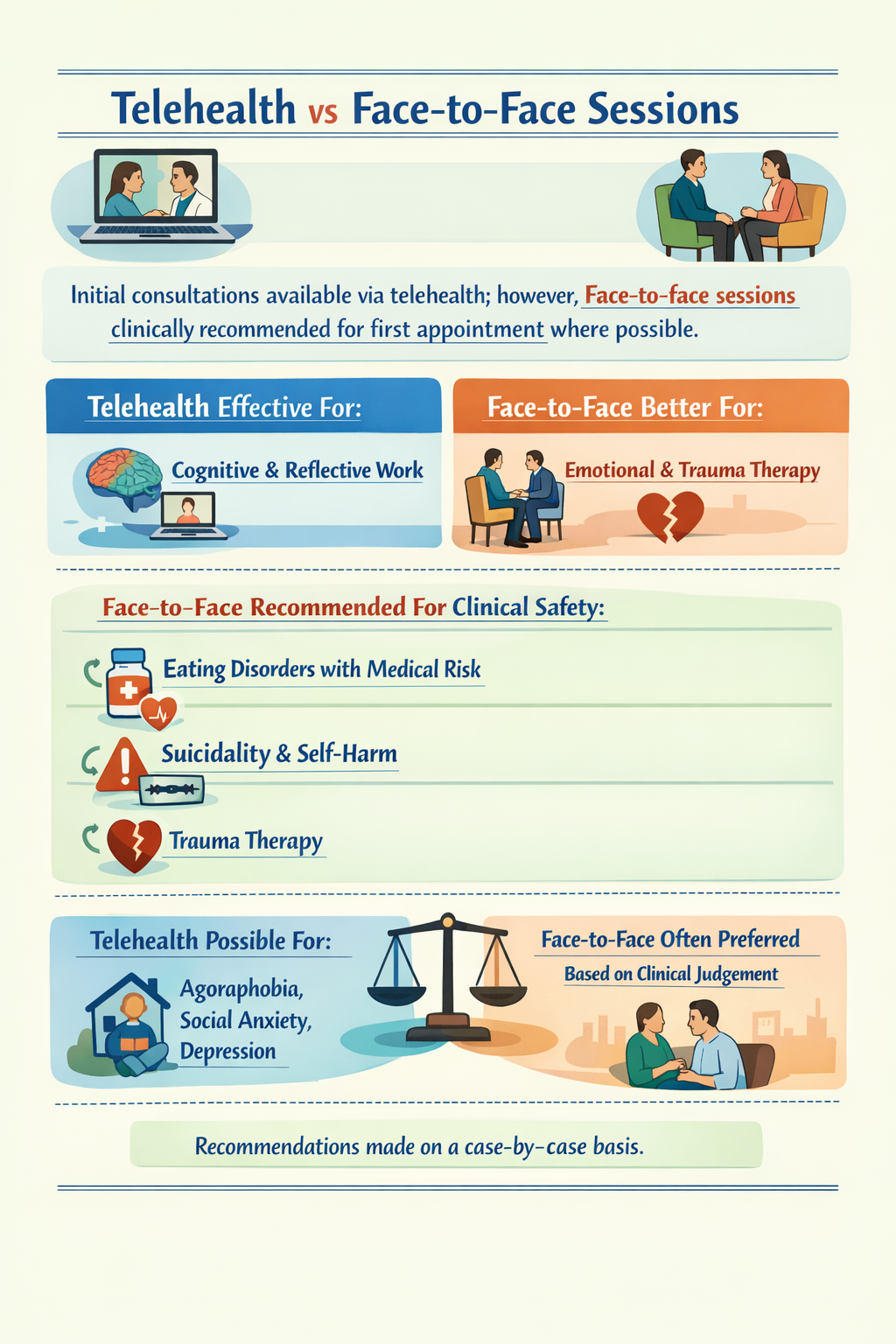
Initial consultations are available via telehealth; however, face-to-face sessions are clinically recommended for the first appointment where possible.
In general, face-to-face therapy tends to lead to better outcomes when available. Telehealth can be equally effective for more cognitive or reflective work, while face-to-face sessions are often more effective for deep emotional processing and trauma work.
Face-to-face sessions are strongly recommended for clinical safety in the following presentations:
Eating disorders with medical risk
Suicidality (thoughts, urges, behaviours, or past attempts) and self-harm
Trauma therapy
For presentations such as agoraphobia, social anxiety disorder, or depression with reduced routine, telehealth is available; however, face-to-face attendance (leaving the house and engaging in person) can itself be a valuable therapeutic component.
I may recommend face-to-face sessions for other presentations based on clinical judgement. This is assessed on a case-by-case basis.
Cancellation Policy
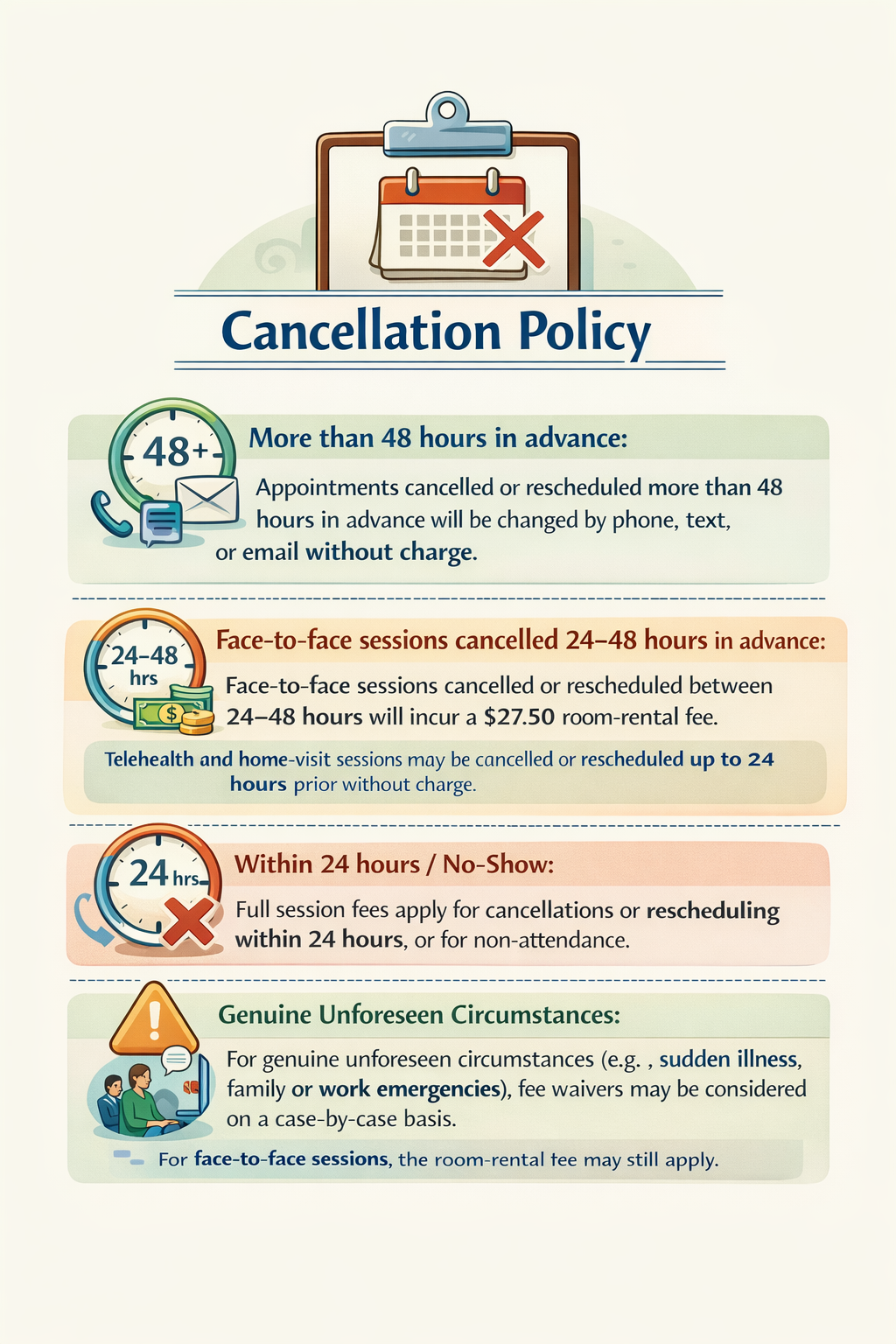
Appointments cancelled or rescheduled more than 48 hours in advance will be changed by phone, text, or email without charge.
Face-to-face sessions cancelled or rescheduled between 24–48 hours will incur a $27.50 room-rental fee, or $55 for initial consultation (2 hours)
Telehealth and home-visit sessions may be cancelled or rescheduled up to 24 hours prior without charge.Full session fees apply for cancellations or rescheduling within 24 hours, or for non-attendance.
For genuine unforeseen circumstances (e.g. sudden illness, family or work emergencies), fee waivers may be considered on a case-by-case basis. For face-to-face sessions, the room-rental fee may still apply.
Consent and Confidentiality
Consent
I provide voluntary services only, which means informed consent is required prior to engagement.
Children under 12 years old:
Parental consent is sufficient for me to become involved. However, if a child actively refuses to engage, individual therapy is unlikely to be effective. For this age group, the majority of therapeutic work is typically conducted with parents or caregivers.
Adolescents aged 12–14:
Consent is generally required from at least one parent or caregiver. The young person’s views and willingness to engage will also be carefully considered.
Adolescents aged 14–16:
Capacity will be assessed on a case-by-case basis. In some circumstances, parental consent may not be required if the young person demonstrates sufficient maturity and understanding (Gillick competence). Independent consent may be accepted if the young person can understand:
The nature and purpose of therapy
The potential risks and benefits
Available alternatives
The consequences of not engaging in treatment
Young people aged 16 and over:
Individuals aged 16 years or older may provide independent consent.
Parenting support services:
Parent-focused sessions do not require consent from the child.
Confidentiality
Confidentiality is a fundamental principle of therapy. Information shared in sessions is kept private, and breaches of confidentiality without lawful reason constitute a legal violation.
However, therapists are legally required to break confidentiality under certain circumstances, including:
When disclosure is necessary to preserve life or prevent serious harm (e.g., contacting emergency services to ensure safety).
Under NSW law, all professionals working with children are mandatory reporters and must report concerns of child abuse, neglect, or maltreatment. In some cases, the therapist may not inform the family if doing so is not in the child’s best interests.
When a GP requests brief progress updates related to a Mental Health Care Plan.
When NDIS funding requires documentation containing relevant clinical information.
At times, sharing information between agencies may lead to better intervention outcomes. For example, liaising with GPs, schools, or other relevant services to exchange information or establish a collaborative care plan. Such disclosure will be discussed with clients, and consent will be sought wherever possible.
Confidentiality in family interventions, particularly those involving children and adolescents, can be complex and may need to be navigated on a case-by-case basis. The following general principles apply:
Information will be shared with caregivers when there are safety concerns, for example:
Disclosure of suicidal intent
Treatment of eating disorders involving medical risk
Disclosure of risk of harm to self or others
If it is believed that sharing certain information with caregivers may cause harm to the child or young person, the therapist may withhold that information from caregivers. For example, if a young person discloses ongoing domestic violence and fears punishment or retaliation from caregivers if the disclosure is revealed.